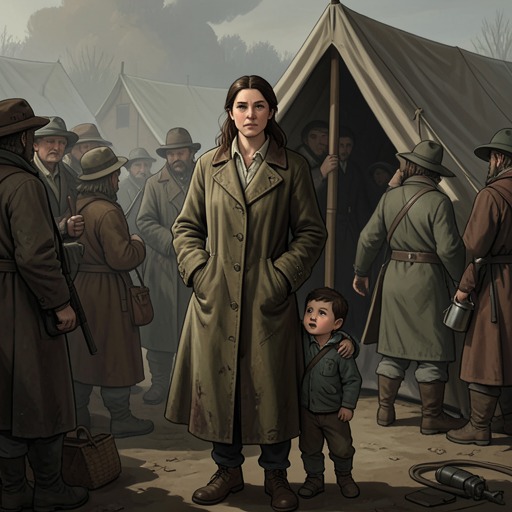
Delphine Watzka
The Master Butchers Singing ClubDelphine Watzka is a compelling, resourceful woman whose toughness was forged by childhood poverty and emotional neglect, but whose sharp eye for performance and deep longing for care remain inseparable. Her path from a miserable North Dakota homestead to the road with Cyprian Lazarre, and then to Eva Waldvogel’s welcoming kitchen, shows both her talent for making a life from little and the unmet need for a motherly bond that still governs her imagination.
Identity and Background
Delphine is introduced in bed with Cyprian in a rented room in a small town near the headwaters of the Mississippi. They have been friends for months, met through theater in Argus, and have only recently begun testing whether their companionship might become love or a joint livelihood. When Cyprian touches her stomach and compliments its strength, Delphine turns onto her back, throws off the covers, and pounds her abdomen to demonstrate that her arms, legs, and stomach are strong. She says she is not ashamed to have grown up on a farm, though she admits she does not know what to do with her strength. The moment sets her physical confidence beside her uncertainty about intimacy.
The account of Delphine’s appearance resists the assumption that a stocky Polish girl from a scrap of a farm should not attract men. She has small, even white teeth, a dimple on one side of her mouth, light brown eyes that look honey-gold in direct sunlight, a strong straight nose, and rakishly uneven ears. She styles her hair with a spit curl on her forehead, two curls beside her ears, and the rest in an elaborate bun. Her direct stare unsettles men, but magnetism does not make her life easier. Her mind is quick, sometimes quicker than she can manage: words surprise even her, and a childhood spent dealing with unpredictable drunks has sharpened her reflexes.
Delphine lost her mother when she was only three or four months old. Her father, Roy Watzka, is a dipsomaniac, and her intense affection for him is described as unappreciated and perhaps misplaced; she remains helpless before his self-pity. Their small homestead survives through a contract with the farmer who leases the land, who refuses to buy it outright. The resulting monthly income goes toward alcohol unless Delphine can steal it away. Her childhood combines material deprivation with the work of trying to manage the damage her father brings into the house.
Performance and Life on the Road
Local theater gives Delphine a way out of the house and a language for imagining another life. She sews bright costumes, practices grand speeches by tragic heroines, and throws herself into Argus productions. There she meets Cyprian, who is honing his balancing act with the town troupe. Their shared interest in performance becomes the basis for leaving North Dakota together and traveling through Minnesota, where towns lie closer together and are less dependent on farming.
Their act turns physical skill into income. Cyprian balances plates on poles held in both arms, on his shoulders and forehead, and even between his teeth; he runs along a line of spinning plates while Delphine takes bets on how long he can keep them moving. For another part of the show, he stacks objects supplied by the audience on his head, including crates of chickens and more dishes, while declining the challenge of a washing machine. He rides a bicycle over wires stretched across fairgrounds and ends a windless night by climbing a flagpole to perform a handstand on its ball. Delphine’s work as the betting-taker makes her an active partner in the act’s business, not merely a spectator to Cyprian’s feats.
Watching Cyprian poised above the fairground, a tiny figure against the black Minnesota sky, Delphine feels a thrill of sympathy. The sight changes how she regards their sexual mismatch: she forgives his lack of sexual heat and decides that his desperate need for her is enough. The choice reveals her willingness to make a partnership out of imperfect terms, while also leaving unresolved whether need can substitute for desire.
After three months on the road, Delphine and Cyprian have earned a startling amount from poor, dusty towns. She takes their success as proof that even in the hard summer of 1934 people will pay for a break from misery. Still, she decides she has to return home. Before going back to Argus, she buys cheap rings for them both at a second-rate jewelry shop, because she cannot appear in town without at least the pretense of marriage. As she slips on her ring, she makes clear that it means nothing to her; Cyprian replies that this is true only from her point of view. The rings turn their public presentation into a performance of marriage, while their exchange exposes a difference in what the relationship means to each of them.
Loss, Memory, and the Need for a Mother
Delphine’s childhood longing survives in small private objects. She believes, though Roy has never confirmed it, that the things in her tiny room once belonged to Minnie Watzka. Among them is a wooden box containing a white stone wrapped in a strip of torn muslin. When longing overwhelms her, she winds the cloth around her wrist and puts the stone in her mouth, tracing its blunt edges with her tongue. The tobacco-and-cedar smell of the cigar box and the repetitive comfort of the scarf and stone give her a private ritual for a need she cannot ask anyone else to meet.
At twelve, Delphine puts the stone away and stops the habit, but does not outgrow the absence it answered. Seeing other girls with their mothers can make her head swim and her neck ache. She has been too stubborn and shy to bring her need to an older woman, such as a teacher or a friend’s mother, even though it remains present—sometimes buried, sometimes urgent. The abandoned childhood ritual thus marks not the disappearance of longing, but its transformation into a more conscious awareness of what she missed.
That history surfaces when Delphine returns to Argus after she and Cyprian struggle with a smell and fear they may have burned down the house. She is relieved that the photographs of her mother, kept by Roy in the top drawer of a black lacquer bureau, are still there. She wants to sit with their familiar mystery and feels an almost physical urge to open the cigar box and take out the stone. As she drives into town, she wishes she could see her mother’s face clearly just once. It is in this fit of longing that she enters Waldvogel’s Meats and meets Eva Waldvogel, joining the search for a motherly presence to the next decisive encounter in her life.
Eva’s Kitchen and a New Sense of Belonging
Eva leads Delphine through the busy spaces of the meat business and into a sunlit kitchen with thick walls and large windows above the sink. The room’s order and abundance are concrete: cupboards painted a striking green, a flour bin, a heavy meat grinder bolted to the counter, and a round table covered in oilcloth printed with fruit. Geraniums bloom at the bare windows, and the kitchen smells of fresh rolls. For Delphine, the room seems to stop time; its furnishings are not merely domestic details but the visible shape of a life she has never had.
As Eva makes coffee, Delphine watches her measure beans from a Redwing crock, grind them with an iron hand crank, empty the grounds into a gray enamel pot, draw water from a faucet, and light a white gas range trimmed in chrome. The sounds and movements produce in Delphine a profound expansion of being, followed by a swooping sensation and quiet, as though she has settled like a bird. Her awed exclamation is met not with ceremony but with Eva’s practical response: Eva takes a pencil from her hair and writes down a mincemeat recipe.
Delphine recognizes Eva as a formidable figure—an assured mother of four sturdy, intelligent sons and the wife of a master butcher. Eva’s old-fashioned German handwriting and poor English spelling make her seem less impossibly perfect, and that small imperfection helps Delphine feel able to approach her. Against the memories of hunger, cold, shameful messes in her father’s home, and a childhood without a mother, Eva’s competence and generosity offer a startling contrast. The kitchen scene gives Delphine’s longing a place to land: the comfort she once sought through a stone and cloth now appears in the warmth of another woman’s ordinary, practiced care.